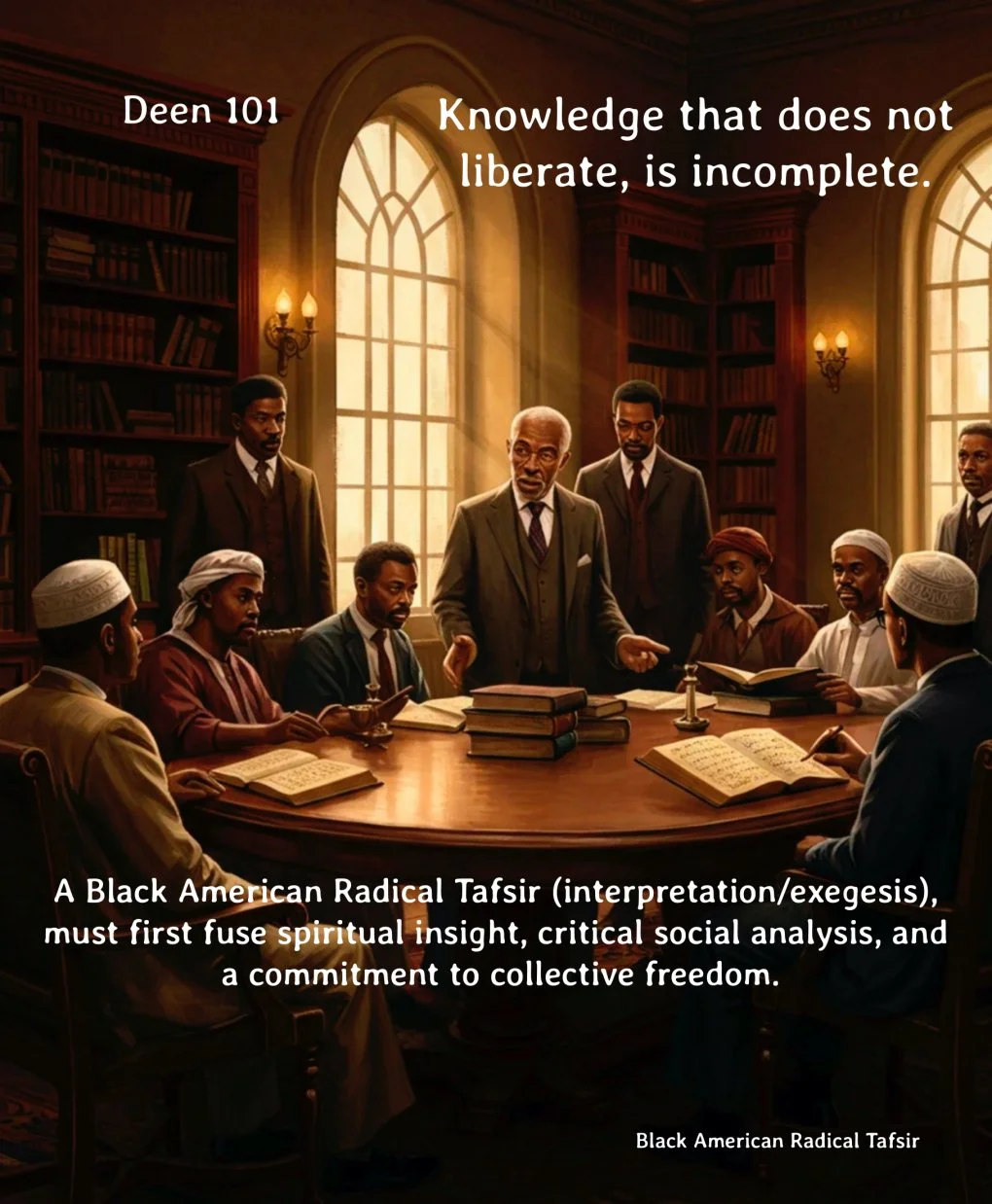
The Custodians of the Sanctuary:
Reversing the Colonial Hierarchy and Healing the Soul Wound
Mahmoud Andrade Ibrahim
To understand the profound implications of Black American Radical Tafsir, we must first confront the unspoken hierarchy that has quietly governed global Islam for centuries. In mainstream Islamic thought, there exists a pervasive, often subconscious, cultural assumption that the "authentic" Muslim is inherently Middle Eastern. Because the Qur’an was revealed in Arabic, and because the Prophet Muhammad (pboh) was an Arab from the Quraysh tribe, the Arab world has historically been positioned as the epicenter of spiritual authority. Within this colonial framework, the faith is viewed as a proprietary product of the East, and everyone else, particularly Black and African-descended Muslims, are relegated to the status of marginalized "converts." They are perceived as latecomers to a foreign tradition, perpetual students who must meticulously emulate Arab cultural norms, linguistic aesthetics, and social habits in order to prove their legitimacy. This is the colonized narrative: the Black Muslim is an adoptee who must bow, assimilate, and seek validation from a hierarchy that treats their presence as a secondary appendage to the Ummah.
But the Black American Radical Tafsir does not accept this narrative. It mercilessly flips this hierarchy on its head, dismantling the very concept of the "convert" and replacing it with an infinitely more potent archetype: the Protector.
To accomplish this, the movement reaches back into the most vulnerable, most precarious moments of Islamic history and pulls forward the figure of the Negus of Abyssinia, King Ashama ibn Abjar. In the standard colonial telling, the Negus is often reduced to a minor footnote, a kind ruler who happened to let a few persecuted refugees stay in his palace. The Radical Tafsir utterly rejects this reductionism. It argues that the Negus was not a convert in the passive, subordinate sense of the word. He was not a supplicant asking for permission to join a foreign religion. Instead, he was a sovereign patron of the Prophetic mission itself. He was the gatekeeper of salvation, the absolute monarch who, by his own divine and sovereign choice, decided to shield the first Muslims from extinction.
When the Quraysh elites of Mecca sent their envoys to Abyssinia, demanding the extradition of the Prophet’s companions, they brought lavish gifts and offered political alliances. They expected the Negus to act as a compliant vassal to the Arabian trade empire, to be bribed into handing over a group of helpless refugees. But the Negus did not bow. He stood in his throne room, asked the refugees to recite the verses of the Qur’an, and wept at their beauty. He recognized the Divine truth not because he was colonized by it, but because his own African soul resonated with it. He refused to hand over the believers, declaring that they would not be betrayed for the price of gold.
Crucially, this act of refusal was not a passive submission to a new foreign spiritual authority. Rather, it was a supremely confident, proactive exercise of African power. The Negus acted from a deeply rooted position of strength, operating entirely within the paradigm of ancient African civility, law, and custom. Abyssinia was not a backwater; it was a highly advanced, ancient Christian kingdom with its own complex legal codes, its own sophisticated court protocols, and its own deeply entrenched traditions of governance.
When the Negus refused the Quraysh, he was not breaking with his own culture; he was perfectly embodying it. The ancient African legal and moral tradition places an almost sacred emphasis on the inviolability of the guest. In the African concept of hospitality, once a stranger has been welcomed into the home or the kingdom, their life is utterly sacred. To betray a guest, especially one who has fled persecution, is not merely a political blunder; it is a profound violation of the cosmic order, a stain on the honor of the entire nation. When the Quraysh tried to buy him with gold, they fundamentally misunderstood the African psychological landscape. They were offering bribes for a transaction that African law did not permit.
The Negus’s weeping at the Qur’an was not a sign of weakness or subjugation; it was the profound recognition of a deep spiritual resonance. His African soul recognized the Oneness of God, the emphasis on justice, the care for the orphan and the weak, because these principles were already native to his ancestral soil. He realized that this new revelation was not an alien religion asking him to abandon his heritage; it was the divine affirmation of the very virtues his ancestors had upheld for millennia, the virtues of justice, righteousness, and unwavering protection of the persecuted. Thus, he protected the Muslims not as a colonized subject, but as a benevolent king operating within the ancient, sovereign tradition of African generosity. He was demonstrating that the highest form of power is not the ability to crush the weak, but the courage to protect them.
This historical moment is the ultimate reversal of the power dynamic. It means that when a Black American Muslim looks into the mirror, he is no longer looking at a follower. He is looking at a custodian of Islamic history. He is the direct spiritual descendant of the man who held the keys to the survival of the Prophet’s community. The relationship is fundamentally inverted. Africa did not ask for permission to enter Islam; Islam asked Africa for permission to survive. In the darkest days of Meccan persecution, when the Prophet’s companions were being tortured in the sands of Arabia, the entire fate of the nascent faith rested not on the wealth of the Quraysh, nor on the military power of the Persian or Byzantine empires, but on the sovereign mercy of a Black African King who obeyed his own ancestral laws.
This historical fact permanently, irrevocably reverses the power dynamic between African-descended Muslims and the Arab world. It destroys the psychological foundation of Arab supremacy in the religious sphere. If the Black African was the first sanctuary, the first host, and the first protector of the Ummah, then the Black Muslim cannot possibly be a subordinate. They are foundational. They are the bedrock upon which the Prophet’s mission survived its earliest trials. Therefore, to demand that Black Muslims subjugate their own cultural identities, ancestral wisdom, and historical realities to Arab cultural norms is not just a social injustice; it is a historical amnesia and a theological fallacy. The Black American Muslim carries a lineage of courage, sovereignty, and patronage that predates and supersedes the modern colonial hegemonies of the Middle East.
However, this ideological reversal is not merely an intellectual exercise; it is a vital therapeutic intervention for a deeply traumatized community. The Black American experience is defined by what theorists like Frantz Fanon identified as "psychic alienation." This is an intergenerational "soul wound", a profound, lingering trauma born from the violent erasure of identity. American chattel slavery was not merely a system of labor exploitation; it was a sophisticated, brutal machine designed to sever the Black man and woman entirely from their past. They stole languages, banned religions, burned ancestral names, and forced a complete rupture from the African continent. For centuries, the Black American was taught to look at their history as a void, to feel like a culturally orphaned people with no tangible, pre-colonial identity to cling to. This void is the deepest source of Black insecurity, the psychic root of the persistent feeling of being "less than" in a white-dominated world.
The mirror reflection offered by the Black American Radical Tafsir acts as a spiritual adoption certificate, a divine legal document that reclaims what was stolen. It says: You are not an orphan. You do not have to fabricate a past. You do not have to construct your identity out of the ashes of trauma.
By linking the Black American ancestor directly to the Prophet’s companions, by reminding them that the same bloodlines that protected the early Muslims still flow through their veins, the Radical Tafsir bypasses the 400 years of American trauma entirely. It reaches back, over the Atlantic Ocean, over the horrific bellies of the slave ships, and taps directly into a 1,400-year-old Afro-Asiatic wellspring. It gives the Black American a pre-colonial, pre-slavery identity that is globally revered. This is not a secondary identity; it is a primary lineage of dignity, leadership, and moral courage that the West cannot diminish.
When the Black American Muslim stands in the mosque and hears the call to prayer, they are no longer thinking, "I am an outsider trying to fit into an Arab tradition." Instead, they stand with the confidence of a host. They embody the spirit of the Aksumite court. They are the protectors of the weak, the sovereign dispensers of sanctuary, the descendants of the kings who wept over the Qur’an and changed the course of history. They remember that their ancestors did not cave to the pressure of the Quraysh, but instead stood firm in the ancient African tradition of refusing to betray the guest.
Ultimately, the Black American Radical Tafsir is an act of radical psychological decolonization. It doesn’t just say that Black people are worthy of respect; it proves that Black people are indispensable to the very fabric of the faith. It replaces the shame of the Middle Passage with the grandeur of the Abyssinian throne. By centering Africa as the cradle of Islamic sanctuary, the movement insists that Black American identity is not defined by the chains that bound them, but by the hand of mercy they once extended to the most beloved of Allah’s creation. The Black man does not look in the mirror and see a descendant of a slave who adopted a foreign creed; he sees a representative of the exact spiritual lineage that extended the first hand of shelter to the Prophet’s persecuted followers. He is no longer a guest in someone else’s house; he has returned home to his own ancestral sanctuary, guided by the ancient African laws of generosity that once saved the very religion he now calls his own.
N O T E S
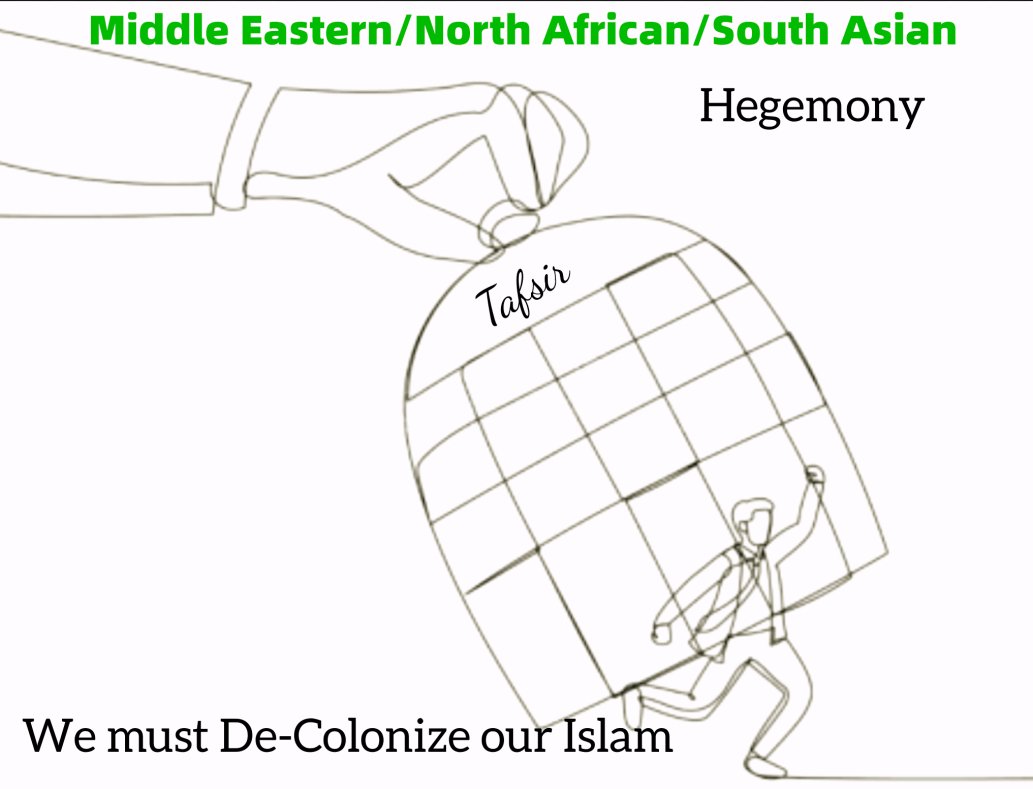
The Status Quo to Dismantle: The "status quo" in Islamic scholarship is often that Arabic language and Arab cultural norms are the only valid sources of Tafsir.
The African Counter-Action: If Islam developed simultaneously in Africa, then African cultural norms, African indigenous wisdom, and the Black experience are not secondary to Islamic interpretation, they are pristine and foundational sources for understanding the Quran.
The Political Implication: If Africa was the first guest and protector of Islam, then the modern struggles of Black people (whether in America or Africa) should be the central focus of Islamic justice. To ignore Black liberation is not just a moral failure; it is a historical betrayal of the continent that saved the faith itself.
The Prophetic mission to the Negus consisted of two distinct phases of migration, which accounts for the extended timeline:
The First Migration (615 CE): An initial group of eleven men and four women fled Mecca to seek refuge in the Kingdom of Aksum .
The Second Migration (616 CE): The following year, a larger group of 83 men (along with women and children) joined them, led by Ja'far ibn Abi Talib . This second group constituted the larger permanent settlement.
The Return to Medina: The majority of the emigrants returned to Mecca in 622 CE to migrate to Medina with the Prophet Muhammad . However, a significant second wave, including key figures like Ja'far, remained in Abyssinia until the 7th year after the Hijrah (628-629 CE), returning to Medina only after the Conquest of Khaybar .
This extended period of refuge highlights the historical depth of the relationship between Islam and Africa.
A Deep-Rooted Connection: The emigrants were able to establish a temporary Muslim community in Africa, with some individuals passing away and being buried there, and others being born during the migration .
Sovereign Authority: The continuity of this group's presence in Aksum for over a decade was a direct result of the Negus's sovereign decision to permanently reject the bribes of the Quraysh, honoring the African legal tradition of protecting refugees and the sanctity of the guest .
By the time the last emigrants returned in 628 CE, this initial shelter had laid a historical and spiritual foundation for Africa's role as an integral homeland for Islamic civilization.