Zayd’s Story
By Mahmoud Andrade Ibrahim
The fluorescent lights of the university’s student center hummed a monotonous, sterile tune, a stark contrast to the fiery rhetoric echoing in Zayd’s headphones. He was listening to a recording of Malcolm X, the sharp, incisive cadence of his voice cutting through the ambient noise of clattering trays and distant laughter. “You can’t separate peace from freedom because no one can be at peace unless he has his freedom.” Zayd nodded, his eyes fixed on the page of his worn copy of The Autobiography of Malcolm X, the margins filled with his own frantic, penciled notes.
He looked up, his gaze sweeping across the table where his peers, members of the campus Muslim Students’ Association, were gathered. They were his brothers and sisters in faith, but in this moment, they felt like strangers. Khalid was animatedly discussing the latest breakthrough in his computer science project, his voice brimming with excitement about algorithms and data streams. Aisha, a hijabi with a perpetually serene expression, was showing Fatima a new brand of halal lipstick she’d found online. Others were scrolling through social media, sharing memes about “Muslim problems” and planning the logistics for the upcoming Interfaith Iftar.
They were good people, Zayd knew. Kind, charitable, and steadfast in their prayers. But their Islam was a faith of personal piety, a spiritual sanctuary detached from the world’s turmoil. Their “ummah” was a global concept, an abstract feel-good notion of brotherhood that only existed in ethereal cyberspace or at the communal iftar table, not in the concrete, often hostile, reality of the American streets they walked every day. Functionally, their engagement with the world was no different from that of the Jehovah’s Witnesses or of Roman Catholicism, traditions of quietist surrender he had rejected as a young teenager.
Zayd felt a familiar, suffocating claustrophobia. He was trying to build a bridge between the profound, world-shaking ideas he was discovering and the placid, apolitical faith of his peers, and the span felt impossibly wide. He wasn't just reading Malcolm; he’d been devouring everything he could find. He’d felt the raw, unflinching power of Richard Wright’s Native Son, understanding Bigger Thomas’s rage not as a simple criminality, but as a product of a society that had rendered him invisible and powerless. Wright’s work was a scalpel, dissecting the American psyche and revealing its festering wound of race, a wound that no amount of polite interfaith dialogue could heal.
Then there was Hubert Harrison, the “Black Socrates,” a figure whose name rarely, if ever, came up in their circles. Zayd had stumbled upon him in a footnote, a brilliant West Indian-American intellectual and activist who, in the early 20th century, fused the militant spirit of the New Negro Movement with a sharp class consciousness. Harrison was a bridge Zayd hadn't known existed. He wasn't just an activist; he was a freethinker, an educator, and a socialist who understood that the struggle for Black liberation was inseparable from the struggle for economic justice. Harrison viewed organized religion with deep skepticism, often dismissing it as a superstitious enterprise that dulled the critical faculties of the oppressed. And yet, even from his secular vantage point, he recognized the raw political and social power that a mobilized faith could wield. He saw how Islam, stripped of its deferential trappings and wielded with militant clarity, could serve as a vehicle for Black consciousness and international solidarity, a framework for breaking the chains of mental and physical slavery, long before Malcolm X would popularize that very same synthesis.
For Zayd, reading Harrison was like watching a master architect lay the foundation for a skyscraper. He could see the design: a potent and liberating faith, wielded not just for personal salvation, but as a tool for dismantling the very structures of oppression that Wright so brutally chronicled. Malcolm X, standing on the shoulders of intellectuals like Harrison, had taken that blueprint and built a skyscraper of Black pride and revolutionary thought. He saw Islam as the ultimate source of power to fight the “devil” of white supremacy.
But here, at this table, the “devil” was just a historical metaphor, a distant bogeyman. The systemic racism that kept Black communities impoverished, over-policed, and under-educated was a problem for sociologists and politicians, not a spiritual crisis demanding a theological response.
“Zayd? Earth to Zayd!” Khalid’s voice cut through his reverie. “What do you think? Should we do a fundraising dinner for the children in Gaza, or a coat drive for the local shelter?”
Zayd blinked, forcing himself back to the present. The question, well-intentioned as it was, felt like a lifeline thrown from a sinking ship. Charity was essential, a pillar of the faith. But it was a bandage, not a cure. It was treating the symptoms while ignoring the disease.
“Both are important,” Zayd said, his voice quiet but firm. “But… if we’re going to do a coat drive, don’t you think we should also be asking why the residents of that shelter, a majority of whom are Black and brown, are there in the first place? Why the systemic poverty? Why the lack of affordable housing?”
The table fell quiet for a moment. Aisha looked up from her lipstick, a puzzled expression on her face. “Well, that’s a social issue, Zayd. We’re just trying to help.”
“Exactly,” Khalid added, eager to get back to his agenda. “We can’t fix everything. We just do our small part. The rest is in Allah’s hands.”
Tawakkal. Reliance on Allah. A beautiful concept, but one that had been twisted into a tool for political passivity. Zayd felt a surge of frustration.
“No,” Zayd said, his voice rising slightly, drawing a few glances from neighboring tables. “It’s not about ‘fixing’ everything. It’s about understanding the why. Our faith isn’t just about praying and fasting and giving charity. It’s about justice. ‘Be steadfast witnesses for Allah in equity,’” he recited the verse from the Quran, “‘and let not the hatred of a people make you swerve from justice. Be just; that is nearer to piety.’”
He looked around the table. “That’s not passive. That’s a command. It’s active. It’s about recognizing injustice when you see it and fighting it. Malcolm understood this. He saw Islam as the tool to unshackle the Black mind and body. He saw the racist system for what it was, not as a societal accident, but as a structure that needed to be dismantled.”
“Yeah, but Malcolm was extreme,” Fatima said, her voice small. “He changed, though. He became more peaceful before he died.”
Zayd shook his head. “That’s a misunderstanding. He became more universal in his view of justice, yes, but he never became passive. He was never ‘peaceful’ in the sense of accepting injustice. He saw racism as a global scourge. And he understood that for Black Americans, liberation couldn’t be separated from our faith. Look at Richard Wright. He was an atheist, but he understood the Black condition in America better than most Muslims I know. He wrote about the rage, the dehumanization, the feeling of being trapped in a prison of other people’s perceptions. Our faith offers the key to that prison, but we have to be willing to use it. We have to know the world we’re in before we can change it, and we have to use our faith as the lens to see that world clearly.”
He was thinking of Hubert Harrison, the intellectual who taught from a soapbox in Harlem. Harrison didn't just preach; he organized, he agitated, he challenged the status quo. He understood that Black liberation in America was a complex war of ideology, economics, and politics. He saw the intersection of all these struggles. That’s the mission Zayd saw for Black American Muslims: to be the inheritors of this radical, intellectual tradition. To be the new Hubert Harrisons, the new Malcolms, using the universal truths of Islam to address the specific, ugly realities of racial injustice in America. To see the prison and to know the key.
He looked at his friends, their faces a mix of confusion, discomfort, and mild annoyance. They didn’t get it. To them, his talk of systemic oppression and revolutionary faith was unsettling, a destabilizing force in their comfortable, well-meaning world. They saw their Islamic identity as a way to be seen as separate from the Black struggle, a shield from its messy, inconvenient realities. Zayd saw it as the very weapon they needed to fight it.
The conversation was not a failure, but a beginning. It was a small seed of dissent, a crack in the placid surface of their collective apathy. He saw the discomfort in Khalid’s eyes, the flicker of curiosity in Aisha’s. The light of understanding was still off, but he had just turned on the switch. The mission was not to convince them all in one day. The mission was to, like his intellectual forebears, plant the seed, ask the difficult questions, and refuse to let the conversation end.
Zayd closed his book and stood up. He had a study group to attend, a class on African American history. He had papers to write and more books to read. He was a student, and his study was his jihad, a struggle against intellectual and spiritual complacency. He walked away from the table, the weight of his mission heavy on his shoulders. He was alone in his understanding, but he was in the company of giants. He could almost hear them, a chorus of voices whispering from the pages of his books, urging him forward: Malcolm, with his righteous fury; Wright, with his brutal honesty; and Harrison, with his unyielding intellect. They were his guides, his teachers, his companions on a lonely but necessary path. And he would not rest until he had helped his community see that the true purpose of their faith was not just to find salvation, but to be a salvation for a people and a world still desperately in need of it.
***************
Notes: Excerpt
“To them, his talk of systemic oppression and revolutionary faith was unsettling, a destabilizing force in their comfortable, well-meaning world. They saw their Islamic identity as a way to be seen as separate from the Black struggle, a shield from its messy, inconvenient realities. Zayd saw it as the very weapon they needed to fight it.’
This passage crackles with a tension that is both historical and painfully contemporary. It captures a fracture that runs deep within American Muslim communities, and indeed, within many marginalized communities navigating the choppy waters of assimilation and resistance.
Zayd and "them" represent two distinct, and often conflicting, political theologies.
1. The "Them": Respectability and the Illusion of the Shield
For "them," Islamic identity is a strategy of spatial and social mobility. They are engaged in what scholars like Mahmoud Mamdani call "good Muslim" versus "bad Muslim" demarcation, but applied racially. By emphasizing piety, modesty, and a depoliticized spirituality, they seek to leapfrog over Blackness and align themselves with the broader, often whiter, American middle class.
The Shield: They view Blackness, particularly the militant struggle against systemic oppression, as a liability. It is "messy" and "inconvenient" because it invites state surveillance, economic isolation, and social stigma. Their Islamic identity becomes a buffer, a way to say, "We are not a threat; we are model minorities who pray five times a day and value family." They see Zayd's rhetoric as a threat not because it is untrue, but because it unmasks their shield as a fragile illusion. It forces them to confront that their piety does not inoculate them from anti-Black racism, police violence, or economic disenfranchisement.
2. Zayd: The Weaponization of Tawhid
Zayd operates from a radically different hermeneutic. He reads the Qur'an and the life of the Prophet (PBUH) not as a set of private rituals, but as a divine mandate for liberation.
The Weapon: For Zayd, Tawhid (the oneness of Allah) is inherently anti-imperial. It means there is no sovereign but Allah, which renders all human hierarchies, including white supremacy, illegitimate. He looks to figures like Malcolm X (post-Hajj), Omar ibn Said, and the West African jihad states, seeing Islam as the faith that armed enslaved Africans with the spiritual and intellectual tools to resist. To him, the Prophet's migration (Hijra) is a blueprint for refusing oppressive systems, and Jihad (in its greater sense of struggle) is the daily work of dismantling racism. His "revolutionary faith" is not a departure from Islam; it is, in his view, its most authentic expression.
3. The Irreconcilable Tension: Proximity to Power versus Solidarity with the Wretched
The conflict is ultimately about reference points.
"Them" reference the dominant culture. Their metric for success is safety, acceptance, and a seat at the table. They see Zayd's activism as jeopardizing that hard-won, fragile foothold.
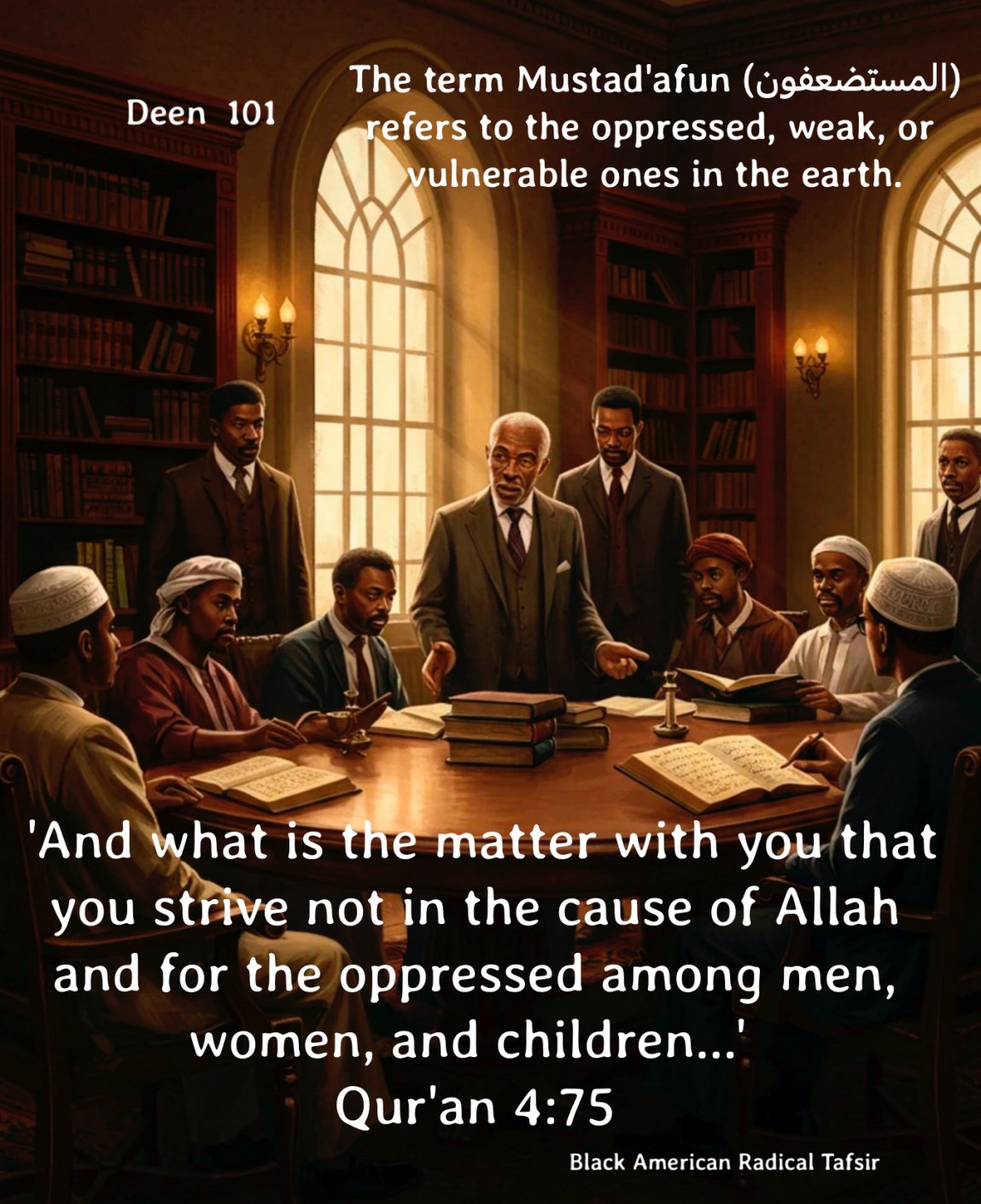
Zayd references the oppressed (al-mustad'afun). His metric for success is the liberation of the most vulnerable, regardless of the cost to his own social standing. He sees their seat at the table as a gilded cage, because the table is built on the very systems that crush Black bodies.
What Zayd understands that they don't:
He knows that their shield is porous. They are not seen as "white-adjacent" by the state; they are seen as Brown and Muslim, subject to the same surveillance and suspicion as their Black siblings. Their attempt to separate from the Black struggle is, in Zayd's eyes, a form of internalized anti-Blackness that will never buy them lasting safety. The only true security, he insists, lies in radical solidarity, because when the state comes for the most oppressed, it will eventually come for them too. The only difference is that Zayd will be in the streets, while "they" will be caught in the middle, their shield shattered.
The Uncomfortable Question:
This passage forces the reader to ask: Is faith a private sanctuary from the world's evils, or is it a public mandate to tear those evils down? Zayd and "them" read the same sacred texts, but they inhabit entirely different universes of meaning. One reads the Qur'an in a suburban prayer hall; the other reads it in the cell of a political prisoner, or on the front lines of a protest.
The tragedy is that both are sincere. But sincerity, as Zayd knows, is not enough. The question is whether that sincerity is willing to risk comfort, status, and even life itself for the sake of justice. That is the revolutionary faith he offers, and that is why it is so terrifying to them.