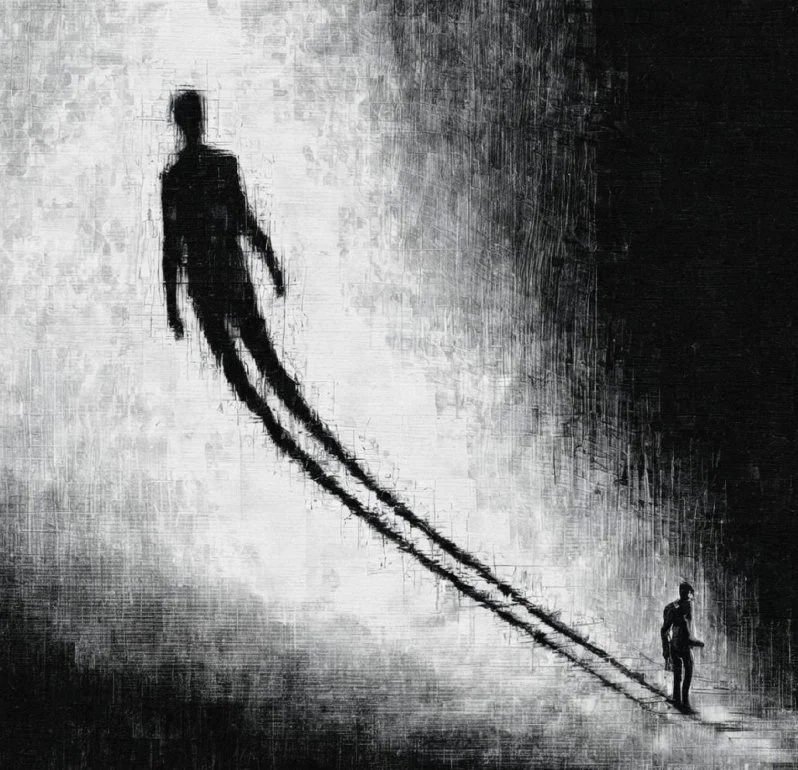
The Scholar's Shadow
Mahmoud Andrade Ibrahim
Amina had always been drawn to light. Not the fluorescent buzz of NYU's lecture halls, but the kind that radiated from men like Shaykh Hamza al-Masri, the kind that made you believe knowledge could save you.
She spotted him across the Kimmel Center auditorium, his white kufi stark against the dimmed lights, his beard trimmed with scholarly precision. Three hundred students had packed the room to hear him speak on "Islamic Ethics in the Modern University," but Amina felt like the lecture had been delivered directly to her soul. When he quoted Rumi on the purification of intention, she'd actually wept.
Afterward, she lingered near the stage as students swarmed him with questions. She clutched her notebook, heart racing. For weeks, she'd been wrestling with a painful contradiction: her Islamic Studies professor had argued that Muslim women should not lead mixed-gender prayers, but everything Amina had read about early Islamic history suggested otherwise. She needed clarity. She needed to understand.
"Shaykh Hamza," she finally managed, her voice smaller than intended. "I have a question about female religious authority. Could I... could I speak with you privately?"
He turned, and his smile was like warm honey. "Of course, my dear. These are important matters. Come, we can talk in my office at the Islamic Center, just a few blocks away."
Amina hesitated for only a second. This is a learned man, she told herself. A man of Allah. I'm being silly.
She followed him through the cold November streets, her breath forming tiny clouds, her boots crunching against fallen leaves. The Islamic Center was quiet, its prayer room empty, the smell of oud lingering in the hallway. He led her to a small office cluttered with books in Arabic and English, closed the door behind them, and gestured to a worn leather chair.
"Please, sit. Tea?"
She accepted, watching him pour from a thermos. His hands were steady, his movements deliberate, the hands of a man accustomed to ritual.
"So," he began, settling across from her, "tell me what troubles your heart."
Amina launched into her question, citing sources, referencing scholars, laying out her confusion with the precision of a student who had spent too many nights in Bobst Library. She felt alive, electrified by the exchange.
Halfway through her argument, Shaykh Hamza leaned forward and placed his hand on her knee.
"You're very passionate," he said softly. "I admire that in a young woman. But you must understand, habibti, that your mind is working against you. You're thinking like a Western feminist, not like a woman of faith."
Amina's throat tightened. The weight of his hand felt wrong, heavy, possessive. But she couldn't move. This was a shaykh. He knew things she didn't. She'd seen him on YouTube, read his books, admired his work for years.
"Perhaps," he continued, his thumb tracing small circles on her jeans, "what you need is a more... personal tutorial. I could mentor you. Guide you away from these confusions. One-on-one."
The words hung in the air like smoke. One-on-one. The same phrase that had felt so innocent ten minutes ago now tasted sour.
I can handle this, she thought, her pulse hammering. I'm a New Yorker. I'm an adult. I can—
But she couldn't. His hand had moved higher, and her body had frozen in that terrible way that happens when your brain screams "run" but your legs won't obey. She stared at the bookshelf behind him, al-Ghazali, Ibn Arabi, Rahman, all the scholars who had taught her to seek knowledge, to revere teachers, to trust.
"Shaykh," she whispered, "I think I should go."
He removed his hand with studied ease, as if he'd merely brushed a piece of lint from her clothing. "Of course, of course. I understand. When you're ready for that deeper guidance, you know where to find me."
Amina stumbled out of the office, down the hallway, past the prayer room, and into the street. The cold air hit her face, and she began to shake. Not from the temperature. From the shame. The confusion. The certainty that somehow, she had done something wrong. She'd asked for a private meeting. She'd wanted to be seen as an intellectual equal. She'd been naive.
On the subway back to her dorm, she scrolled through her phone. There was a group chat from the Muslim Students Association, excited texts about the lecture, about how inspiring Shaykh Hamza was. Someone had posted a photo of him smiling at the podium.
Amina's thumb hovered over the keyboard. She could tell them. She should tell them.
But then what? He'd deny it. She had no witnesses. No proof. And he was beloved—a community pillar, a respected scholar. Who would believe a second-year undergraduate over a man who had dedicated his life to Allah?
She typed: "Wasn't he amazing?"
The lie hit send before she could stop herself.
That night, she lay awake, replaying the moment in her head. The weight of his hand. The honey-sweet voice. The way he'd made her feel like she was the problem, the confused Western girl who couldn't submit.
She thought about her mother, an immigrant from Morocco who had always warned her: "Be careful of men who know too much scripture." She thought about her aunt, who had been touched by an imam during her childhood in Casablanca, a secret the family never discussed.
And she thought about all the other young women who had sat in that auditorium, dazzled by the light of a man who used knowledge as a weapon.
Amina grabbed her journal and began to write, her handwriting shaky in the dark:
"I thought I could handle it. I thought I was smart enough, strong enough. But they don't warn you about the way it feels when someone uses your faith against you. They don't tell you that the most dangerous men are the ones who make you feel like Allah is watching, but only through their eyes. I'm okay. I escaped. But I keep wondering: what if I hadn't? What if I was the girl who didn't know how to say no? What if I was the girl who believed, truly believed, that he held the keys to Jannah?"
She closed the journal and stared at the ceiling.
In the morning, she would delete the group chat message. She would pretend the lecture never happened. She would throw herself into her coursework and avoid the Islamic Center forever.
But she would also start reading about trauma. About grooming. About the patterns she'd just lived through. And slowly, quietly, she would begin to understand that the fault was never hers.
The light she'd been chasing had been a mirage. The real work, the harder, lonelier work, was learning to see in the dark.