The Ship That Would Not Sail
Mahmoud Andrade Ibrahim
The good ship Umma drifted.
She was a fine vessel, her hull sound, her sails patched but serviceable, her crew fed and warm. She had been built by hands that knew suffering, launched by a generation that had dreamed of open water. And now she sat, dead in the water, in the middle of an ocean so vast and featureless that a reasonable sailor might forget there was anywhere else to go.
On deck, the morning prayer had just concluded. The sailors rose from their prostration, folded their prayer rugs, and settled into the comfortable rhythm of another day at sea. They were, by any measure, a contented people. They prayed five times a day, and they prayed well. Their recitation was precise, their posture impeccable, their dhikr rhythmic as the slap of water against the hull. They had memorized the words in a language most of them did not speak, and they repeated those words with the devotion of people who had inherited them from their ancestors, which, in fact, they had.
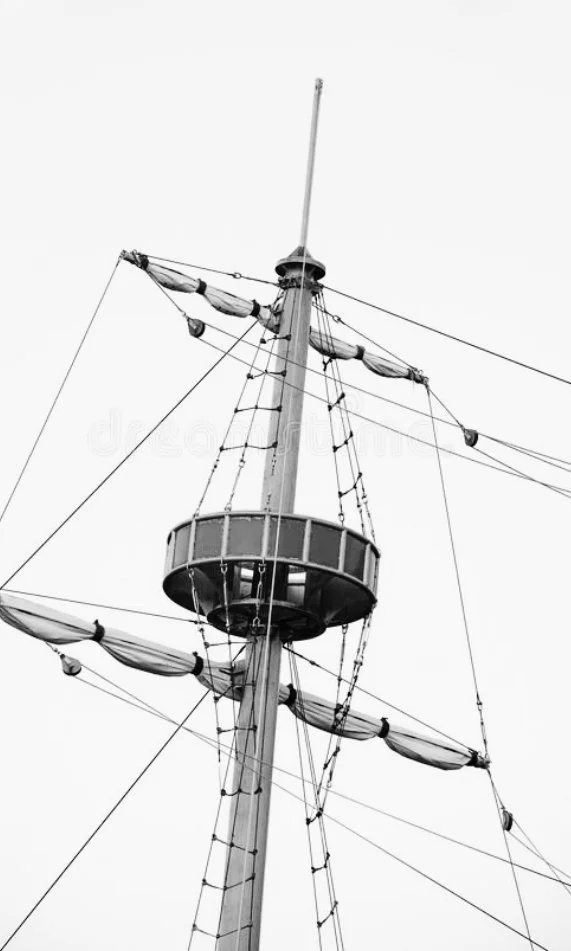
The Crow’s Nest of The Good Ship Ummah
"We are a blessed people," said the bosun, a man named Yusuf who had served on the ship for forty years. "Look at us. We have the prayer. We have the community. We have the food and the drink and the brotherhood. What more could we ask for?"
The crew murmured their agreement. They had heard this speech before, many times, and it had become like the creaking of the mast, so familiar that it no longer registered as sound. They went about their duties: coiling rope that did not need coiling, polishing brass that did not need polishing, counting supplies that did not need counting. The ship did not move, and so the duties were ceremonial. They were the rituals of a people who had forgotten what the rituals were for.
Somewhere on the horizon, if anyone had bothered to look, there might have been land. There might have been a storm. There might have been another ship, approaching with either trade or threat. But no one looked at the horizon. The horizon was uncertain, and the deck was comfortable, and the prayer rug was warm.
The old man in the crow's nest was named Bilal, and he had not been content for a very long time.
He had been up there for three days, which the crew found eccentric but forgivable. The crow's nest was not a popular post on a ship that went nowhere, and so Bilal's presence there was tolerated as the harmless quirk of an old sailor. But Bilal was not being quirky. He was looking.
He was looking at the water as the swells moved, at the direction of the wind, at the birds that appeared and disappeared on the horizon. He was looking at the stars, which he had learned to read from his grandfather, who had learned from his grandfather, who had come from a land across the sea. He was looking at the sun and the shadows, and he was doing something that no one else on the Umma had done in a very long time.
He was navigating.
"Where are you trying to take us?" asked a young sailor one afternoon, squinting up at Bilal. The sailor's name was Safwan, and he had been born on the ship. He had never seen land, except in stories.
"To somewhere," Bilal said. "Anywhere."
"That sounds dangerous," Safwan said.
"It is," Bilal said. "But so is staying."
Bilal had a book. It was a heavy thing, bound in cracked leather, its pages marked with the annotations of a dozen hands. It had been passed down through his family for generations, and it contained not only the sacred words that everyone on the ship knew by heart, but also the meanings behind the words, and the applications of the meanings, and the history of a people who had once moved across the water and had not been content to drift.
In Bilal's hands, the book was not a relic. It was a map.
The crew of the Umma had their own copies of the sacred words, and they recited them beautifully. But they recited them the way a parrot recites a poem, without understanding, without application, without the living interpretation that made the words a compass rather than an anchor. They had learned the words from their ancestors, and they had learned them so thoroughly that they had become the words. They were seven-centuries-removed clones of a people who had once been alive, repeating the forms of devotion without the substance, because the forms were safe and the substance required movement.
Bilal understood this, because Bilal had been that kind of sailor once. He had prayed the prayers and kept the fasts and worn the garments, and he had been content, and he had gone nowhere. And then one day, he could not say exactly when, he had looked out at the horizon and realized that the ship was drifting, and that the drifting was killing them slowly, and that no one else had noticed.
He had gone to the captain. The captain had listened patiently and then said, "What would you have us do? Sail into the unknown? We have the prayer. We have the community. We are blessed."
And Bilal had understood, in that moment, that the captain was not a navigator. The captain was a caretaker. The captain's job was to keep the ship stable, not to move it. And a ship that is kept stable in the middle of the ocean is a ship that is sinking, inch by inch, into the indifference of the water.
So Bilal had climbed into the crow's nest, and he had begun to look.
The old book had a word for what had happened to the crew of the Umma. It called them muqallidun, imitators, and it warned against the imitation that hardens into stagnation. It told stories of a people who had been given a revelation and had turned it into a cage, who had memorized the law and forgotten its purpose, who had built monuments to their ancestors and then refused to move beyond them.
The book also had a word for what Bilal was doing. It called it tafsir, interpretation, explanation, the act of reading the sacred words in the context of the present moment. And it had a phrase that Bilal repeated to himself every time he climbed the rigging: the text is alive for the living.
The crew of the Umma had the text. They had it in their heads and on their lips and woven into the fabric of their daily lives. But they had forgotten that the text was meant to be read anew by each generation, by each people, in each place. They had forgotten that the words were not a destination but a direction.
Bilal began to write. He wrote in the margins of the old book, and he wrote on scraps of paper, and he wrote on the backs of old charts that no one else wanted. He wrote about the water and the wind and the stars. He wrote about the crew and their contentment and their fear. He wrote about the America that lay across the ocean, a land of both promise and peril, a land where his ancestors had been brought in chains and where their descendants now prayed on a ship that would not sail.
He wrote about the need for a new interpretation, a radical interpretation, one that would take the sacred words and use them not as a lullaby but as a compass. He wrote about the Black American experience as a text to be read alongside the sacred text, a story of struggle and survival that demanded a theology of liberation. He wrote about the danger of the cloned faith, the faith that reproduces the forms of the seventh century without reproducing the spirit of movement and justice that had animated the seventh century in the first place.
He wrote: The prayer that does not lead to navigation is not prayer. It is anesthesia.
One morning, the captain called Bilal down from the crow's nest.
The crew had assembled on deck. They were nervous. They had seen Bilal's writings, passed from hand to hand, and they had argued about them in the mess hall and the sleeping quarters. Some said he was a heretic. Some said he was a fool. Some said nothing, and listened, and looked at the horizon when they thought no one was watching.
"You have been writing," the captain said. "You have been saying that we are drifting. You have been saying that our prayers are empty. You have been saying that we need a new interpretation."
"I have been saying that we need to sail," Bilal said.
"And where would you have us sail?"
Bilal pulled out the old book. He opened it to the margins, where his own words were written alongside the words of his ancestors. He read aloud:
"We are a people who pray. But are we a people who produce? The prayer that does not produce justice is a clanging bell. The prayer that does not produce institutions is a hollow echo. The prayer that does not produce a future is a funeral rite. We have been praying for seven centuries, and the ship has not moved. It is time to pray the kind of prayer that moves."
The crew was silent. The water slapped against the hull. The horizon waited, uncertain and vast and alive.
"I am not asking you to abandon the prayer," Bilal said. "I am asking you to remember what the prayer is for. The prayer is a compass, not an anchor. The prayer is a map, not a monument. The prayer is a call to move, not a call to stay."
He closed the book.
"I am going to set a course," he said. "I am going to navigate toward the America that lies across the water, the America that is both our ancestral prison and our present home. I am going to interpret our sacred words in the light of our lived experience, and I am going to use that interpretation to steer this ship into the uncertain waters of the present. I am going to be a Muslim who prays and produces."
He looked at the crew.
"Who will sail with me?"
The silence lasted a long time. It was the silence of people who had been content for so long that they had forgotten how to want anything else. It was the silence of cloned faith, of repeated forms, of prayers that had become the sound of the ship not moving.
And then Safwan, the young sailor who had never seen land, stepped forward.
"I will," he said.
And then another. And another. And another.
The Umma did not sail that day. But Bilal climbed back into the crow's nest with a new book in his hands, a book written by himself and Hamza and the others who had chosen to look at the horizon, and he began to chart a course.
The water was uncertain. The future was uncertain. But the ship was moving.
And the prayer, at last, had produced something.
And the sea, which had waited so long for the ship to remember its purpose, opened before them like a page.